An Indian wedding DJ is a culturally fluent music director and MC team that designs the energy arc for multi‑event celebrations. From our Atlanta base at 800 Spring St NW, Revel Entertainment integrates DJ, MC, lighting, LED walls, and logistics so each baraat, sangeet, and reception runs on time and keeps guests dancing.
By Revel Entertainment • Last updated: June 14, 2026
Indian Wedding DJ: Complete Guide & Table of Contents
Use this complete guide to plan entertainment that’s musically on point and technically bulletproof. You’ll learn what an Indian wedding DJ really does, why production matters, how our process works, and which tools—from LED walls to Atlas venue intelligence—turn a great playlist into a full‑room experience.
Here’s what you’ll find below. Skim now, dive deep later, and bookmark for planning calls:
- Clear definition of an Indian wedding DJ and how MCs shape flow.
- Why production (sound, lighting, visuals) makes music felt, not just heard.
- Our five‑stage process from consult to showtime, including site visits.
- Approaches that fit different crowds: open‑format, traditional, club‑style, hybrid.
- Battle‑tested best practices for a packed dance floor and smooth timelines.
- Tools we use: Atlas venue intelligence, LED walls, smart lighting, mobile rigs.
- Local planning notes for Midland in Muscogee County.
- Real‑world snapshots from Atlanta, Midland, and Charlotte weddings.
- FAQ answers you can use in planner emails.
If you’re a planner or a couple mapping a multi‑event weekend, this guide doubles as a checklist. Use it to align creative direction, logistics, and vendor roles so the energy builds all weekend without burnout.
Quick Summary
An Indian wedding DJ curates Bollywood, bhangra, and Western hits while an MC hosts with cultural fluency. Pairing that talent with engineered sound, lighting, visuals, and logistics keeps guests engaged, speeches clear, and the dance floor full from baraat to afterparty.
- Who it’s for: South Asian and Indian couples planning multi‑event weekends.
- Why it works: One integrated team aligns music, tech, and timelines.
- Core tools: Venue intelligence (Atlas), tuned audio, smart lighting, LED walls.
Most receptions run 4–5 hours with 2–3 major dance blocks. Plan energy in waves, protect speeches with tuned audio, and validate special‑effects permissions before you fall in love with a look.
What Is an Indian Wedding DJ?
An Indian wedding DJ mixes Bollywood, bhangra, hip‑hop, and global hits while a culturally fluent MC guides formalities. The role spans baraat through afterparty and integrates sound, lighting, visuals, and logistics—transforming a playlist into a choreographed experience.
In our experience, the strongest results come from open‑format mixing that reads the room in real time. A great DJ/MC team:
- Bridges generations: 90s Bollywood and Punjabi anthems into today’s remixes without whiplash.
- Hosts with warmth: MCs cue entrances, toasts, and performances without stealing the spotlight.
- Designs to space: Sound, lighting, and visuals are engineered to the room and guest count.
- Owns logistics: Load‑in, vendor comms, and permits are mapped before showtime.
Core responsibilities you can expect
- Music programming: Segment‑specific playlists for baraat, sangeet, reception, and afterparty.
- MC flow control: Smooth transitions that keep traditions and timelines intact.
- Technical oversight: Coordinating audio, lighting cues, and visual moments.
- Risk management: Backup gear, RF coordination, and weather plans for outdoor segments.
Most baraats run 45–60 minutes. Receptions average 240–300 minutes across cocktail hour, dinner, formalities, and open dance. Knowing those bookends helps us shape momentum while protecting the couple’s time for photos and greetings.
Why the DJ + Production Team Matters
Your DJ sets the tone, but production makes it felt. Music curation, engineered sound, lighting, and visuals work together to lift entrances, keep toasts intelligible, and turn good sets into unforgettable rooms where guests stay and dance longer.
Here’s what most people don’t realize: the right rig can increase dance‑floor dwell time. When sub placement is balanced and lighting supports the drop instead of fighting it, you see more guests move early and stay longer.
- Speech intelligibility: Directional mics and tuned PA keep toasts clear at every table.
- Room coverage: Multi‑zone audio avoids hot spots and dead zones in ballrooms.
- Visual coherence: Uplighting, movers, and LED walls tied to the music’s story arc.
- Timeline discipline: A showcaller coordinates vendors so you hit cues on time.
For outdoor baraats, battery systems with weather‑resilient speakers and tight RF channels protect against dropouts. Indoors, we often add front‑fills and delays to keep the front rows comfortable and the back rows engaged without blasting the center.
How an Indian Wedding DJ Works with Full Production
Great results come from one integrated team: consult, music questionnaire, design and logistics, venue site visit, and showtime. We validate capacity, rigging, power, and effect rules early, then run a cue‑based show so each moment lands on beat and on time.
Our five‑stage process
- Consult: Define vision, guest mix, sensitivities, and must‑plays/do‑not‑plays.
- Music & mood questionnaire: Preferences by segment—baraat, sangeet, reception, afterparty.
- Design & logistics: Sound, lighting, LED walls, staging, run of show, vendor map.
- Venue site visit: Validate capacity, rigging points, power paths, load‑in, and effect permissions.
- Showtime: DJ/MC, showcaller, audio, lighting, and LED techs execute a cue‑based show.
| Segment | Music Direction | Production Elements |
|---|---|---|
| Baraat | High‑tempo bhangra + dhol + hype hits | Mobile PA, battery power, wireless mics, shade planning |
| Sangeet | Family performances + crowd‑pleasers | Stage wash, confidence monitors, cueing, playback control |
| Reception | Open‑format: Bollywood, hip‑hop, classics | Dance‑floor lighting, spotlights, LED wall visuals, sub alignment |
| Afterparty | Club‑forward remixes at higher energy | Low‑light ambiance, haze, tighter sub response, extended hours |
In our show files, every entrance, spotlight, and effect gets a cue number. That’s how we keep creative spontaneity while preserving structure. It’s also why planners love partnering—surprises disappear when each moment has a tech plan behind it.

Types of Indian Wedding DJs and Approaches
Most South Asian weddings thrive with open‑format DJs who blend Bollywood, bhangra, and Western hits. Other approaches—traditional‑only, club‑style, or hybrid band + DJ—work when matched to guest mix, venue rules, and the story you want to tell.
Open‑format (most versatile)
- Strength: Reads the room and moves across languages and eras without losing flow.
- Best for: Mixed‑generation guest lists and receptions over 250 guests.
Traditional‑forward
- Strength: Deep catalog knowledge of regional classics and ghazals.
- Best for: Ceremonial segments, elder‑friendly dinners, refined sangeet programs.
Club‑style
- Strength: Fast transitions, festival drops, remix‑heavy blocks for afterparties.
- Best for: Late‑night rooms where energy needs to hit peak and stay there.
Hybrid band + DJ
- Strength: Live vocals, dhol, or sax layered over DJ sets to heighten key moments.
- Best for: Grand entrances and choreographed first‑dance moments.
Match the approach to your timeline. For a three‑day flow, you might mix traditional‑forward sangeet with an open‑format reception and club‑style afterparty—one story, different chapters.
Best Practices for a Packed Dance Floor
Lock the dance floor by shaping energy in waves, stacking multi‑generational anthems, and using lighting to accent drops. Clear MC cues, clean transitions, and quick pivots based on crowd response keep momentum high without burning out guests.
Programming that works
- Energy waves: Build 20–30‑minute peaks, then add breathers for photos and the bar.
- Run stacking: Nostalgia → remixes → universal singalongs to pull in all ages.
- Dynamic transitions: Use tempo bridges and key matches to avoid dead air.
Production that supports the mix
- Lighting as a verb: Color sweeps and strobes should accent beats, not compete.
- Protect vocals: Prioritize mic discipline and EQ that keeps speeches clear.
- Sub alignment: Tighten low‑end near the dance floor to move feet, not tableware.
People‑first details
- Photo windows: Drop tempos after big moments so elders and families step in.
- Bar queues: Time breathers with beverage service to reduce wait frustration.
- Pivot speed: If a lane slows, change within 2–3 tracks to regain the room.
We’ve found that when couples pre‑select 10–15 “north star” songs and give us room to read the room, the night feels personal without getting rigid. That balance is everything.
Tools and Resources We Use
We integrate music direction with production design: Atlas venue intelligence, tuned sound systems, LED walls, smart lighting, wireless mics, and weather‑ready mobile rigs. These tools make timelines reliable, entrances cinematic, and dance floors magnetic.
- Atlas venue intelligence: Confirms capacity, rigging, power, and effect rules before booking.
- LED walls & projection mapping: Transform rooms with story‑driven visuals.
- Smart lighting: Uplighting, moving heads, and pixel bars synced to BPM and cues.
- Sound engineering: Arrays, fills, and subs tuned to your room and guest layout.
- Mobile baraat systems: Battery power, weatherproofed speakers, and RF coordination.
Curious how venues think through tech moments? This overview of wow‑factor features shows how modern rooms use lighting and screens to elevate events—useful context when imagining sangeet or reception looks. See a concise breakdown of tech features that wow.
And if you enjoy peeking under the hood of complex show orchestration, this reflection on “ten years of orchestration” maps neatly to wedding production: lots of moving parts, one coherent outcome. It’s a helpful analogy for showcalling discipline in large ballrooms. Explore the orchestration challenges perspective.
Planning for Midland and Muscogee County
For Midland weddings across Muscogee County, plan entertainment around neighborhood venue rules, outdoor sound, and seasonal heat. Validating power and effect permissions early prevents surprises and keeps your baraat, sangeet, and reception running smoothly.
Local execution hinges on thoughtful logistics and guest comfort:
- Neighborhood sound plans: Outdoor processions need smart routing and volume control.
- Heat and hydration: Summer baraats benefit from shaded staging and shorter blocks.
- FX compliance: Cold sparks, haze, or fog require written venue approval in advance.
Local considerations for Midland
- Schedule outdoor segments earlier in peak summer to keep guests comfortable.
- Coordinate procession routes with venue staff so arrivals, parking, and load‑in don’t collide.
- Plan backup weather coverage for baraats and entrances; alternate routes save timelines.
We routinely stage hydration stations for processions and pre‑rig shaded DJ positions to protect gear and talent. Small moves like these raise participation and keep energy high through the reception.
Case Studies and Real‑World Examples
Real weddings prove the point: the best Indian wedding DJs succeed because production supports the music. These snapshots show how integrated planning—from LED walls to mobile baraat rigs—turns potential risks into signature moments guests remember.
Atlanta ballroom, 450 guests
- Challenge: Keep toasts intelligible across a wide room while maintaining dance energy.
- Move: Added front‑fills and delays for coverage; aligned subs to the floor footprint.
- Result: Clear speeches and earlier‑than‑usual floor activation during the first dance block.
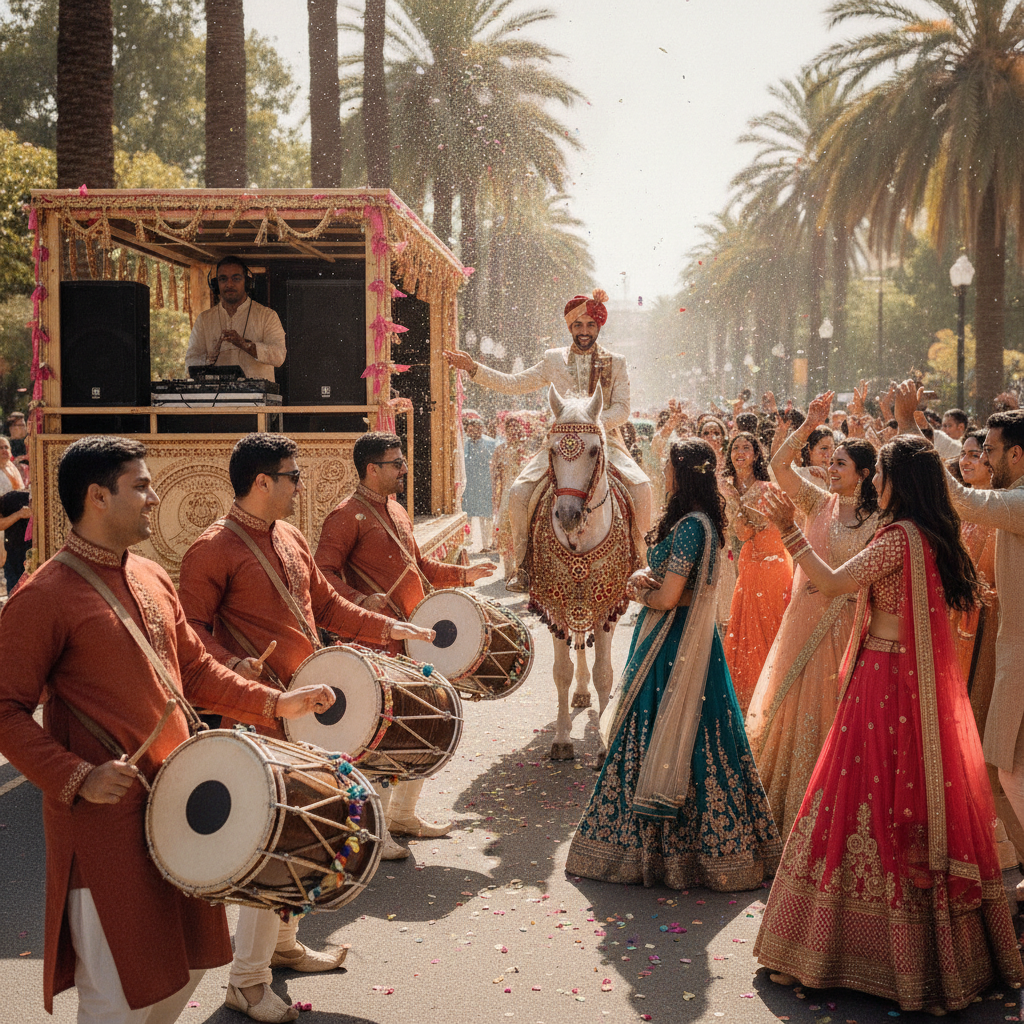
Midland outdoor baraat
- Challenge: High heat and long procession route risked guest fatigue.
- Move: Battery‑powered PA with staged shade and built‑in water breaks every 10–12 minutes.
- Result: Procession stayed hype; guests arrived energized for ceremony and lunch.
Charlotte hotel reception
- Challenge: Multi‑generational crowd with strong 90s nostalgia and current club tastes.
- Move: Open‑format set stacked nostalgia → modern remixes → universal singalongs.
- Result: Longer dance‑floor dwell time and fuller final block before send‑off.
For another angle on venue‑driven planning, skim a venue blog’s running notes on Indian weddings; it’s a quick way to see how rooms consider timeline and guest flow. Here’s a compact venue perspective on Indian weddings.
Indian Wedding DJ FAQ
Quick answers to common planning questions—talent selection, music prep, production needs, and travel readiness—so you can make confident decisions fast.
How early should we book our DJ and production team?
Most couples secure entertainment 9–12 months out, earlier for holiday weekends. Locking talent first helps every other vendor align to sound, lighting, and timeline realities for a smoother planning path.
Can we mix Bollywood, bhangra, and Western hits?
Absolutely. Open‑format mixing is essential for multi‑generational crowds. Share must‑plays and any do‑not‑plays; we’ll build sets that flow between languages and eras without losing energy.
Do venues allow cold sparks or haze?
Policies vary. We confirm permissions in writing during site visits and design alternatives when effects aren’t allowed so the experience still lands and timelines stay intact.
What does your team handle on the wedding day?
DJ and MC lead the room while showcallers, audio, lighting, and LED techs execute cues, manage microphones, and coordinate with planners and venues so the schedule holds and moments land.
Can you travel for destination weddings?
Yes. Our Atlanta‑based team travels worldwide with standardized show files and logistics checklists, delivering the same standards at any venue.
Plan With Revel: Soft Consult Invite
Ready to align music, production, and logistics in one plan? A short consult clarifies your vision, timeline, and venue realities so decisions get easier and your weekend feels effortless.
What you’ll get from a quick consult:
- Music and mood alignment for each segment (baraat, sangeet, reception, afterparty).
- A preliminary production map covering audio, lighting, LED walls, and staging.
- Scheduling notes and a venue reality check powered by Atlas.
Conclusion and Next Steps
An Indian wedding DJ delivers best results when paired with engineered production and clear logistics. Define your vibe, align tech to the venue, and appoint one integrated team to run the show. That’s the formula for a full dance floor and a stress‑free weekend.
Key takeaways
- Open‑format skill, cultural fluency, and production design create the magic.
- Atlas‑driven planning eliminates surprises before anything is booked.
- Energy waves and people‑first details keep guests engaged for hours.
Action steps
- Share your vision and must‑plays/do‑not‑plays.
- Complete a segment‑by‑segment music questionnaire.
- Schedule a venue site visit to validate power, rigging, and FX permissions.
- Lock a cue‑based showfile and timeline with your planner.
We’re based in Atlanta and ready to travel. When you’re ready, let’s craft a room that feels alive and a night that lives in memory.
Related Guides
Planning deep dives that pair well with this Indian wedding DJ guide—use these topics to align vision, logistics, and guest experience across your weekend.
- Designing LED wall visuals that tell your story.
- Creating a run of show that balances tradition and dance energy.
- Building a mobile baraat rig and weather plan.
- Lighting design for intimate ceremonies vs. club‑style afterparties.